
Dark energy is the name scientists give to whatever is making the universe expand faster and faster. Nobody knows what it is. Astronomers can measure its effects across billions of light-years, and NASA estimates it makes up roughly 68% to 70% of everything in the cosmos, yet it has never been seen, bottled or detected in a lab.
What is dark energy in simple terms?
Dark energy is an unknown something that acts like a push on space itself, driving galaxies apart at a rising speed. It is a label for an observed effect, not a substance anyone has identified.
Here is the basic story, as NASA tells it. The universe began about 13.8 billion years ago with the big bang. For billions of years afterward, gravity from all the matter in the cosmos slowed the outward rush. Then, around 9 billion years after the beginning, the expansion started to speed up instead. Something was overpowering gravity on the largest scales, and scientists called it dark energy.
Researchers have several ideas about what it could be. One is that empty space has a built-in energy of its own. Another is a field that fills space and can change over time, nicknamed quintessence. Some physicists suspect there is no new ingredient at all and that Einstein’s theory of gravity needs adjusting at cosmic distances. None of these has been confirmed.
Did Einstein believe in dark energy?
Not as we understand it today, since the accelerating expansion was not discovered until 1998. But a term Einstein added to his own equations, the cosmological constant, is now one of the leading explanations for dark energy.
Einstein’s general theory of relativity was first used to describe a universe that stayed the same size forever. He included the cosmological constant to counterbalance gravity so that universe would hold still. After Edwin Hubble confirmed in 1929, with observations by Milton Humason, that galaxies are rushing away from us, Einstein dropped the term. According to physicist George Gamow, Einstein called it his “biggest blunder.”
When astronomers found in the late 1990s that the expansion was speeding up, some scientists revived the idea with a value greater than zero, linking it to a possible background energy of empty space. That explanation has a well-known problem. Theory predicts either vastly more of this energy than we see or none at all, a mismatch NASA says is still unresolved.
How did scientists discover dark energy?
Two competing teams found it in 1998 by studying distant exploding stars and noticing they were fainter than expected. That work earned the 2011 Nobel Prize in Physics.
One team, the Supernova Cosmology Project, was led by Saul Perlmutter of Lawrence Berkeley National Laboratory and the University of California, Berkeley, and got underway in 1988. The other, the High-z Supernova Search Team, was headed by Montana-born Brian Schmidt starting in late 1994, with Adam Riess of Johns Hopkins University and the Space Telescope Science Institute in Baltimore, playing a crucial role.
Both groups tracked type Ia supernovae, explosions of old, compact stars that shine with a predictable brightness. That makes them useful as cosmic yardsticks. Together the teams found more than 50 distant supernovae that looked dimmer than they should have, meaning they were farther away than a slowing universe would allow. The only sensible reading was that the expansion had sped up. The Royal Swedish Academy of Sciences, which awards the physics prize, noted that the result surprised even the scientists who found it.
Can humans use dark energy?
No. There is no known way to capture, tap or even directly touch dark energy, and scientists still do not know what it is.
Part of the reason is scale. NASA describes dark energy as weak over small distances and dominant only across vast stretches of the cosmos. Within a galaxy, a planet or a human body, far stronger forces hold everything together, so dark energy has no practical effect on everyday matter. Scientists infer its presence from how the universe as a whole expands, not from any device that can sense it nearby.
How will NASA’s Roman Space Telescope measure dark energy?
Roman will map how the universe expanded and how its structure grew over most of cosmic history, using several independent methods that check one another.
NASA’s Nancy Grace Roman Space Telescope launched on a SpaceX Falcon Heavy on August 30, 2026, and is bound for a spot about a million miles from Earth. NASA says it will see images as sharp as Hubble’s across a field of view 100 times larger. Its surveys are expected to capture tens of thousands of supernovae and hundreds of millions of galaxies. Roman will also look for faint imprints of sound waves that rippled through the young universe, called baryon acoustic oscillations, and it will measure how gravity from intervening matter subtly bends light from distant galaxies.
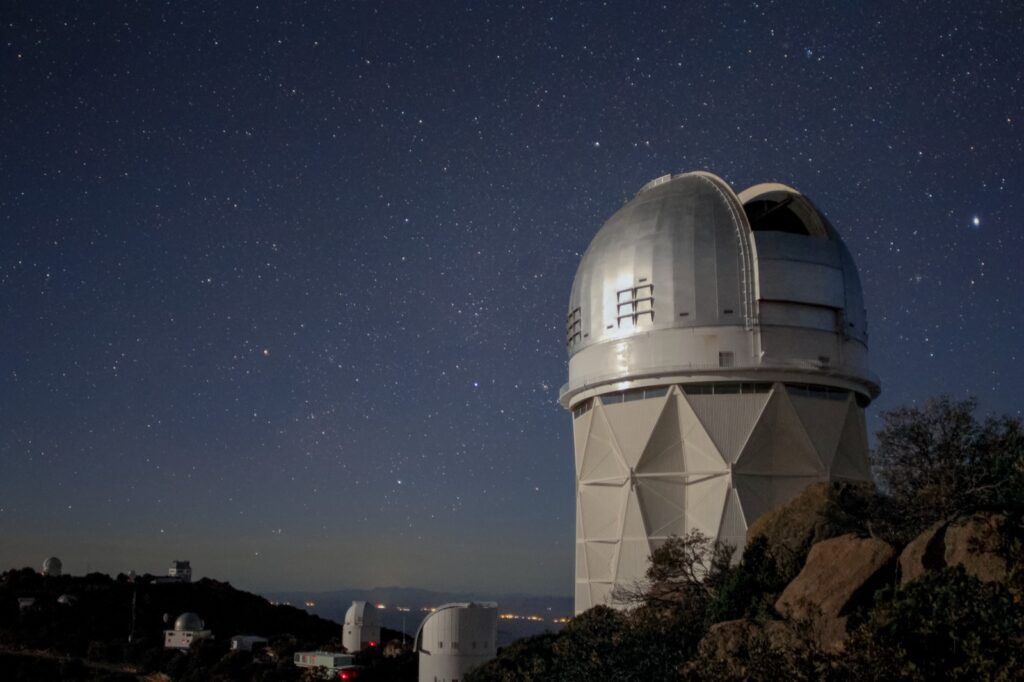
The timing matters. In March 2025, the Dark Energy Spectroscopic Instrument, an experiment managed by the U.S. Department of Energy’s Lawrence Berkeley National Laboratory and mounted on the Mayall telescope at Kitt Peak in Arizona, reported hints that dark energy may be weakening over time. Its analysis drew on nearly 15 million galaxies and quasars. Combined with other data, the evidence ranged from 2.8 to 4.2 sigma, short of the 5-sigma level physicists treat as a discovery. NASA says Roman, working alongside the Vera C. Rubin Observatory and Europe’s Euclid mission, could help settle whether dark energy is truly changing.
What is the difference between dark energy and dark matter?
Dark matter pulls things together, and dark energy pushes the universe apart. Both are invisible, but they have opposite effects and are thought to be completely separate phenomena.
Dark matter has mass and gravity. It does not give off, absorb or reflect light, but its pull holds galaxies and galaxy clusters together. Astronomer Fritz Zwicky noticed signs of it in 1933, when galaxies in the Coma Cluster moved too fast for their visible mass to hold them. In the 1970s, Vera Rubin found the same “missing matter” problem in the outer edges of spiral galaxies. NASA estimates that dark matter makes up about 27% of the universe and ordinary matter, everything from stars to people, only about 5%. Dark energy accounts for the rest.
Put simply, dark matter explains why galaxies do not fly apart, while dark energy explains why the space between galaxy clusters keeps stretching faster. The Royal Swedish Academy of Sciences has called dark energy perhaps the greatest puzzle in physics today.
For more questions about space, physics and research, see our Science FAQ.