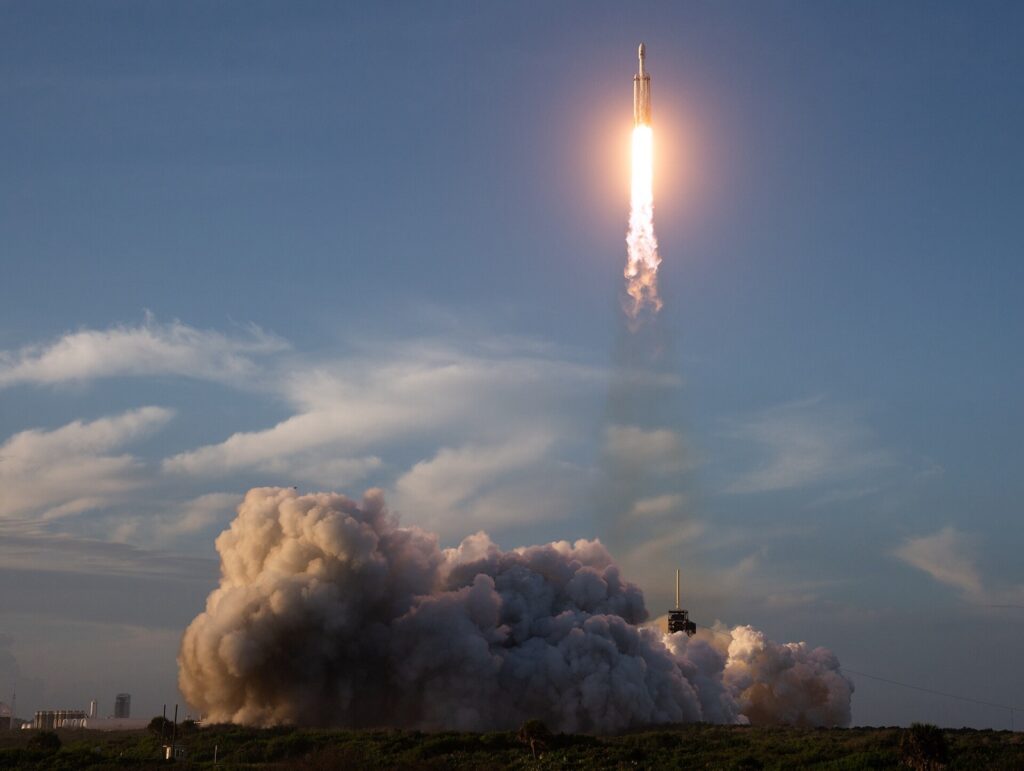
NASA’s Nancy Grace Roman Space Telescope is on its way to deep space after launching on Sunday morning, August 30, aboard a SpaceX Falcon Heavy rocket from Launch Complex 39A at the Kennedy Space Center in Florida. Liftoff came at 7:26 a.m. EDT.
The agency’s newest flagship observatory is designed to study dark matter, dark energy and planets beyond the solar system by surveying enormous stretches of the sky in infrared light. NASA said the telescope can scan the cosmos a thousand times faster than the Hubble Space Telescope.
A clean ride to orbit
Falcon Heavy’s 27 Merlin engines carried the telescope off the pad. About two and a half minutes into the flight, the rocket’s two side boosters shut down and separated, then flew back to land at Cape Canaveral Space Force Station, Space.com reported. The core stage separated about four minutes after launch.
Ground controllers at NASA’s Goddard Space Flight Center in Greenbelt, Maryland, began receiving data from Roman seven minutes after liftoff. The rocket released the observatory 31 minutes into the flight, and the team confirmed one hour and 23 minutes after launch that Roman’s solar panels and lower instrument sun shade had deployed successfully, according to NASA.
NASA Administrator Jared Isaacman praised the mission’s management. “Roman is exactly the kind of success story we want to see across NASA,” Isaacman said. “Delivered ahead of schedule and on budget, this mission reflects more than a decade of dedication from the NASA workforce and our industry partners.”
Earlier this year, NASA’s Launch Services Program worked with SpaceX to move the launch date forward because the telescope was finished early. Roman is the fourth primary NASA mission to fly on a Falcon Heavy. Space.com reported that the project represents more than a decade of work and about $4 billion in development, and that it uses hardware originally built for an unused spy satellite.
Journey to L2
Roman is headed to the second Sun-Earth Lagrange point, known as L2, roughly one million miles from Earth. The location keeps the Sun, Earth and Moon behind the spacecraft so its sensitive instruments face away from their glare. NASA’s Deep Space Network took over communications about 70 minutes after launch, starting with the Canberra station in Australia before handing off to Madrid and then Goldstone in California.
Over the coming days, controllers plan to deploy the telescope’s high-gain antenna and a visor-like aperture cover, perform the first of two mid-course corrections and switch on the Coronagraph Instrument. The main camera, called the Wide Field Instrument, will be turned on a few weeks into the trip. It is a 300-megapixel infrared camera made up of 18 4K detectors.
Roman will spend about three months being tested and calibrated. NASA expects to release its first images by early 2027.
Billion-pixel views of the sky
Dominic Benford, program scientist for Roman, described the scale of the images the observatory will collect. “The smallest Roman images will be a billion pixels,” he said during the launch broadcast, as reported by Space.com. “When we take a billion-pixel image, there isn’t a screen on Earth large enough to display all the pixels.”
The telescope is expected to return 1.4 terabytes of data each day, the highest rate of any NASA astrophysics mission so far. Machine learning, artificial intelligence tools and volunteer citizen scientists will help sort through the flood of data.
Julie McEnery, Roman’s senior project scientist at Goddard, said one planned survey of the Milky Way will catalog 20 billion stars. “That would make it the largest catalog of astronomical objects that’s ever been produced,” she said during live commentary, according to Space.com.
The Coronagraph Instrument will test technology for blocking the glare of stars so that faint planets beside them can be photographed. NASA says it will image Jupiter-like planets and help prepare for future missions, including the proposed Habitable Worlds Observatory, that would search for Earth-like planets.
“Roman will be a discovery machine that will bring us closer than ever before to answering humanity’s most profound questions about our cosmic history,” said Nicky Fox, associate administrator for NASA’s Science Mission Directorate.
Named for the “Mother of Hubble”
The observatory honors Nancy Grace Roman, NASA’s first chief astronomer and the first woman to hold an executive role at the agency. Her early advocacy for a space-based telescope helped lead to Hubble, earning her the nickname “Mother of Hubble.” She died in 2018.
Roman is managed at Goddard with participation from NASA’s Jet Propulsion Laboratory, Caltech/IPAC and the Space Telescope Science Institute. BAE Systems, L3Harris Technologies and Teledyne Scientific and Imaging are the main industrial partners, with contributions from ESA, JAXA, the French space agency CNES and Germany’s Max Planck Institute for Astronomy.