
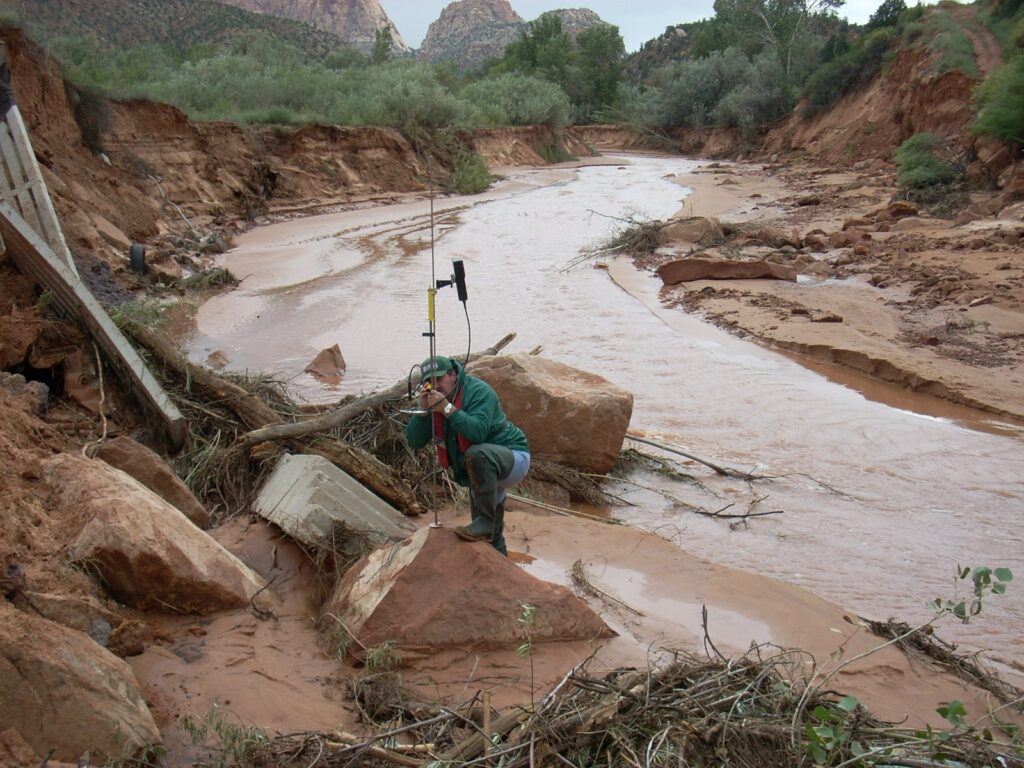
A flash flood is flooding that arrives within minutes to a few hours of the heavy rain, dam failure or other sudden surge of water that causes it. Because the water climbs so fast, people caught near creeks, washes, canyons and low roads often have little time to get out, which is what makes flash floods so deadly.
Two recent stories show the danger. In late August, a torrent swept through Bright Angel Canyon and killed two Texas men, as we reported in our coverage of the Grand Canyon flash flood search. In October, flooding and freezing weather from Rachel’s remnants left about 70 runners and volunteers stuck in the Utah backcountry during the Moab 240 ultramarathon. Here is what the term means, how floods are graded and what the warnings ask you to do.
What does “flash flood” mean?
In National Weather Service usage, a flash flood is flooding that starts within six hours of its cause, and frequently within three hours. That short fuse is the whole difference between a flash flood and the slower river flooding that can build over days.
The usual trigger is extremely heavy rain from thunderstorms. The NWS office serving Philadelphia and Mount Holly, New Jersey, also lists failed dams or levees and mudslides, which it calls debris flows, as causes. How quickly the water rises depends on how hard and where the rain falls, the shape of the land, the type and wetness of the soil, and how much vegetation covers the ground.
Cities are especially vulnerable. Pavement and rooftops do not let rain soak in, so runoff rushes to low spots, and the same storm can flood an urban street sooner and worse than a nearby suburb or field. The weather service also warns that a flash flood can reach places where little or no rain is falling, because the storm may be dumping water farther upstream.
What are the 5 stages of a flood?
There is no single official five-step scale, but the National Weather Service tracks rising rivers with a ladder of terms that works like one: action stage, minor flooding, moderate flooding, major flooding and record flooding. Each level is set separately for every river gauge.
- Action stage: the water level at which forecasters or local partners need to start preparing for possible trouble.
- Minor flooding: little or no property damage, though water may spill over banks and into yards and pose some risk to the public. The NWS typically issues a flood advisory for events expected to stay at this level.
- Moderate flooding: some buildings and roads near the stream take on water, and some people may need to evacuate. A flood warning is called for.
- Major flooding: widespread inundation of buildings and roads, with significant evacuations needed.
- Record flooding: water that matches or beats the highest stage or flow ever measured at that site.
Between action and minor sits “flood stage,” the gauge height at which rising water starts to threaten lives, property or commerce. A flash flood can leap through several of these levels in an hour, which is why forecasters stress acting on warnings rather than waiting to see the water.
What is the biggest flash flood in the world?
There is no agreed global ranking, since records, definitions and death tolls vary widely from country to country. In the United States, the flood with the largest loss of life was the 1889 disaster in Johnstown, Pennsylvania, which was set off by a dam failure.
What was the worst flash flood in US history?
By deaths, it was Johnstown. The South Fork Dam gave way on May 31, 1889, sending roughly 20 million tons of water into the city and killing 2,209 people, according to the National Park Service, which preserves the site as the Johnstown Flood National Memorial.
Among floods driven mainly by rain, the June 9, 1972, flood in Rapid City, South Dakota, stands out. Thunderstorms dropped as much as 15 inches of rain near Nemo and Sheridan Lake in the Black Hills, and Rapid Creek rose as much as 3.5 feet in 15 minutes, according to the NWS office in Rapid City. Debris clogged the spillway of Canyon Lake Dam, which failed late that night and added to the flood. The disaster killed 238 people, destroyed 1,335 homes and wrecked about 5,000 cars.
What is worse, a 100-year flood or a 500-year flood?
A 500-year flood is the larger and rarer event. It has about a 0.2% chance of being equaled or exceeded in any given year, compared with a 1% chance for a 100-year flood, the U.S. Geological Survey explains.
The names mislead many people. A 100-year flood is not a flood that comes once a century on a schedule, and two can strike the same river in back-to-back years. The USGS also notes that the 100-year level for a river is a statistical estimate that can shift as more years of data arrive or as dams and development change how water moves through a basin.
Can you build in a 100-year floodway?
Usually not, unless engineers can show the project will not raise flood levels. Federal rules for communities in the National Flood Insurance Program treat the floodway as land that must stay open to carry floodwater.
Under federal regulations, a regulatory floodway is the river channel plus the nearby land that has to be reserved so the “base flood,” the flood with a 1% annual chance, can pass without pushing the water surface up more than a set height. Communities draw the floodway so the base flood does not rise more than one foot at any point. Inside it, they must bar fill, new buildings, substantial improvements and other development unless hydrologic and hydraulic studies done to standard engineering practice show the work would not increase flood levels during the base flood.
Which US cities are most likely to be underwater by 2050?
NOAA does not rank cities that way. Its most recent national sea level report, released in 2022, instead projects how much the ocean will rise along U.S. coasts and how often high-tide flooding will occur.
That report projects 10 to 12 inches of sea level rise along the U.S. coastline over the following 30 years, with coastal flooding expected to happen, on average, more than 10 times as often as it does now. It offers scenarios for every state and territory, and NOAA’s National Sea Level Explorer lets readers look up local projections. Coastal flooding from higher seas is a separate hazard from flash flooding, though heavy rain can make both worse at once.
What is the difference between a flash flood watch and a flash flood warning?
A watch means conditions are favorable for flooding, so it is time to prepare. A warning means a flash flood is happening or about to happen, and anyone in a flood-prone spot should move to higher ground right away.
The NWS uses a third alert, the flood advisory, for flooding that is expected to be a nuisance rather than a threat to life, though it can still turn dangerous for people who are careless. The agency has also been moving its flash flood warnings to an impact-based format meant to spell out the expected damage more clearly.
The most important safety rule is to stay out of moving water. Flooding kills more people each year than any other hazard tied to thunderstorms, and more than half of flood drownings happen when someone drives into floodwater, the weather service says, citing the Centers for Disease Control and Prevention. Six inches of fast-moving water can knock an adult off their feet, about a foot of rushing water can float away most cars, and two feet can carry off SUVs and pickups. The road under the water may also be gone. The NWS campaign sums it up in four words: Turn Around, Don’t Drown.
For more questions about weather, safety and other national topics, see our U.S. FAQ.
Sources
- National Weather Service, Philadelphia/Mount Holly: Flash Flooding Definition
- National Weather Service: Flood Warning vs. Watch
- National Weather Service: Turn Around Don’t Drown
- National Weather Service, Alaska-Pacific River Forecast Center: Flood Terminology
- National Weather Service, Rapid City: The 1972 Black Hills-Rapid City Flood
- National Park Service: Johnstown Flood National Memorial
- U.S. Geological Survey: The 100-Year Flood
- Legal Information Institute: 44 CFR 59.1: Definitions
- Legal Information Institute: 44 CFR 60.3: Flood plain management criteria for flood-prone areas
- NOAA: 2022 Sea Level Rise Technical Report