
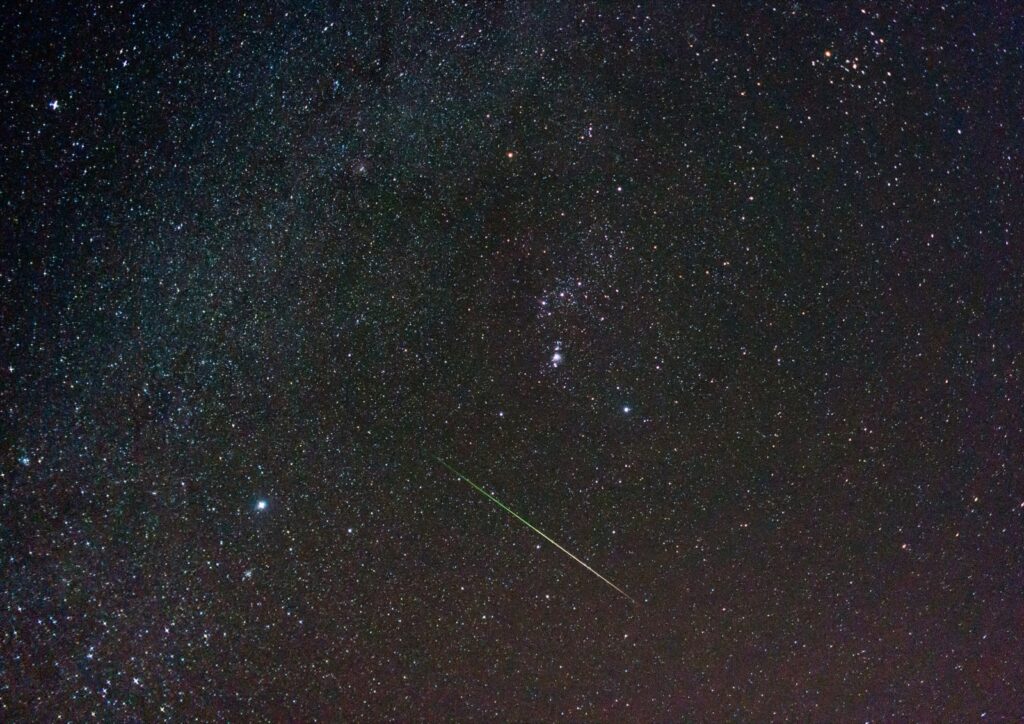
The Leonid meteor shower, one of the best-known annual displays in the night sky, peaks this week, and skywatchers across the United States will have a good chance to see it. The best window runs from late Tuesday night, November 17, until dawn on Wednesday, November 18.
No meteor storm is expected this year, but patient observers under dark skies can still catch the fast, bright streaks the shower is known for.
When to watch
EarthSky predicts the peak for 0:00 Coordinated Universal Time on November 18, which is 7 p.m. Eastern on Tuesday, November 17. The radiant, the point in the sky the meteors appear to come from, rises around midnight and is highest at dawn, so the hours after midnight usually offer the most meteors. EarthSky suggests the morning of November 17 might also be worth a look.
The shower is active for weeks around the peak. EarthSky lists its run as November 3 through December 2, while the Royal Observatory Greenwich gives November 6 to 30. If clouds cover the peak, meteors continue at a lower rate for several days on either side.
The moon this year
Moonlight is often the biggest obstacle for meteor watchers. In 2026, the moon reaches first quarter at 11:48 UTC on November 17, according to EarthSky. The Royal Observatory says the moon will set just before midnight on the peak night, leaving the rest of the peak free of its glare. EarthSky notes that the quarter moon may reduce the count somewhat in the evening hours.
How many meteors to expect
Under a dark sky with no moon, observers might see 10 to 15 Leonids an hour, EarthSky says. City and suburban skies will show far fewer. Most astronomers reserve the word “storm” for showers that produce more than 1,000 meteors an hour, which is not forecast this year.
Where to look
The Leonids are named for the constellation Leo, the Lion, because their paths trace back to the area of the stars that form the lion’s head. EarthSky says the radiant sits near the star Algieba.
You do not need to find the radiant to see the shower. Meteors often do not become visible until they are about 30 degrees from it, and they appear in all parts of the sky. The Royal Observatory recommends a safe, open spot away from streetlights where you can scan a wide stretch of sky.
Tips for watching
- Use your eyes. No telescope or binoculars are needed, and they narrow your field of view.
- Give your eyes time to adjust to the dark, and avoid looking at bright phone screens.
- Bring a comfortable chair and dress warmly, since you may be outside for a while.
- Be patient. Meteors arrive unevenly, with quiet stretches between them.
Where the meteors come from
The Leonids are debris from Comet 55P/Tempel-Tuttle. William Tempel of Marseille Observatory discovered the comet on December 19, 1865, and Horace Tuttle of Harvard College Observatory found it independently on January 5, 1866, EarthSky recounts. The comet orbits the sun about once every 33 years and is due back in early 2031.
As Earth passes through the trail of tiny particles the comet has left behind, the debris hits the atmosphere at speeds of up to 70 kilometers per second and burns up, the Royal Observatory explains. Some particles are no larger than a grain of sand.
A history of storms
Roughly every 33 years, around the comet’s return, the Leonids have produced true meteor storms. The Royal Observatory lists storms in 1799, 1833, 1866, 1966 and 1999 to 2001. The 1833 display is estimated at 100,000 meteors an hour. In 1966, rates reached thousands of meteors per minute during a 15-minute span on the morning of November 17, according to EarthSky.
This year’s shower will be far quieter, but bright Leonids can still surprise. EarthSky encourages anyone who sees an especially bright fireball to report it to the American Meteor Society.