Search teams in Grand Canyon National Park on Wednesday, September 2, kept up their hunt for a hiker who has been missing since a flash flood roared through Bright Angel Canyon on Saturday, August 29, killing two members of his group.
The National Park Service identified the two men who died as John Giusti, 46, and Brent Rosenkranz, 42, both of Granbury, Texas. Park rangers recovered their bodies on Sunday and Monday. The missing hiker is Timothy Allen Smith, 53, a pilot who grew up in Granbury and now lives in Star Valley, Wyoming, Arizona’s Family reported in a story carried by KOLD. Their families said the three were lifelong friends who had been looking forward to fishing and hiking in the canyon together.
On Wednesday, the Border Patrol Search, Trauma and Rescue unit, known as BORSTAR, searched on foot near Phantom Ranch while river patrols worked downstream along the Colorado River. Coconino County Search and Rescue and the park service’s Investigative Services Branch are also working the case alongside park staff.
Count of missing falls sharply
In the first days after the flood, the park service had asked the public for help locating about 15 people who were thought to be missing or unaccounted for. “The National Park Service is asking the public to provide information for approximately 15 individuals who may be missing or unaccounted for following a significant flash-flood event,” the agency said in a statement reported by Al Jazeera. By September 1, the park said only one member of the hiking group remained missing, as rangers confirmed the safety of others.
The park service is still asking anyone with information about people who may have been hiking or backpacking in Bright Angel Canyon or nearby on August 29 to call its tip line.
A sudden downpour on soaked ground
The flood began on Saturday afternoon. National Weather Service meteorologist Darren McCollum in Flagstaff said between half an inch and an inch of rain fell in roughly 20 minutes on a steep, rocky slope. Two smaller storms had already drenched the area hours earlier, Al Jazeera reported, citing The Associated Press. “So when the main storm moved in, torrential rain fell on everything that was already soaked, and that caused all the problems that we’re seeing,” McCollum said.
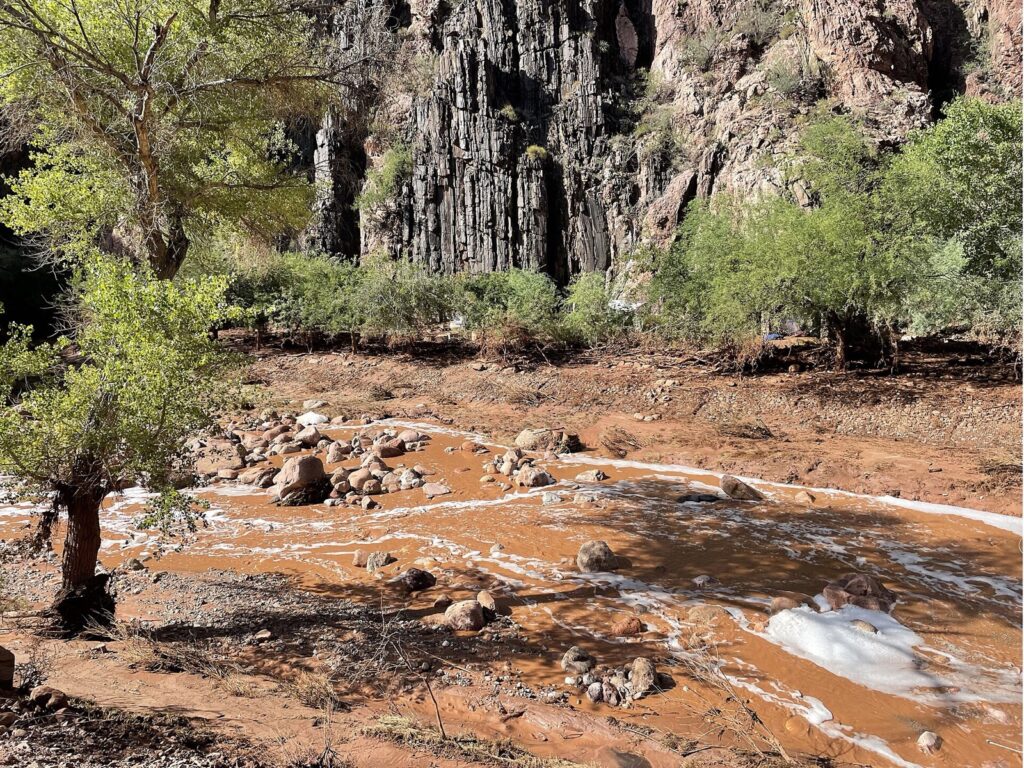
The surge in Bright Angel Creek, which runs into the Colorado River, swept boulders, metal structures and other debris downstream. It destroyed footbridges over the creek, widened the creek bed and appeared to create a new rapid. At least 60 people were evacuated from the Bright Angel Canyon and Phantom Ranch area.
Parth Desai, who was hiking through a narrow section of the canyon with a group of fellow doctors and a park ranger when the rain began, described the scene to the AP. “We saw the creek flood, waterfalls coming up out of nowhere; boulders, mud, landslides happening everywhere,” he said.
Water line knocked out, lodging closed
The flood also crippled the Transcanyon Waterline, the only pipeline supplying water to the park’s residents and visitors. The park service said about 40 percent of the line was damaged or destroyed. As a result, visitors cannot stay overnight at lodges and hotels inside the park until further notice.
Bright Angel Campground, Phantom Ranch and parts of the North Kaibab Trail were closed while officials assessed the damage, and rafting trips on the Colorado River were halted. Park officials scheduled a community meeting for Wednesday evening to brief residents and employees on the water supply, pipeline repairs and the ongoing search and cleanup.
Arizona Gov. Katie Hobbs said the state’s Department of Emergency and Military Affairs was working with the park service and county emergency managers. “My heart is with the families and loved ones of every person unaccounted for after the flash flooding at the Grand Canyon,” Hobbs wrote on social media.
Jack Schmidt, director of the Center for Colorado River Studies at Utah State University, told the AP that the disaster showed the forces that continue to shape the canyon. “This is a reminder of what a dynamic and active landscape Grand Canyon is,” he said.