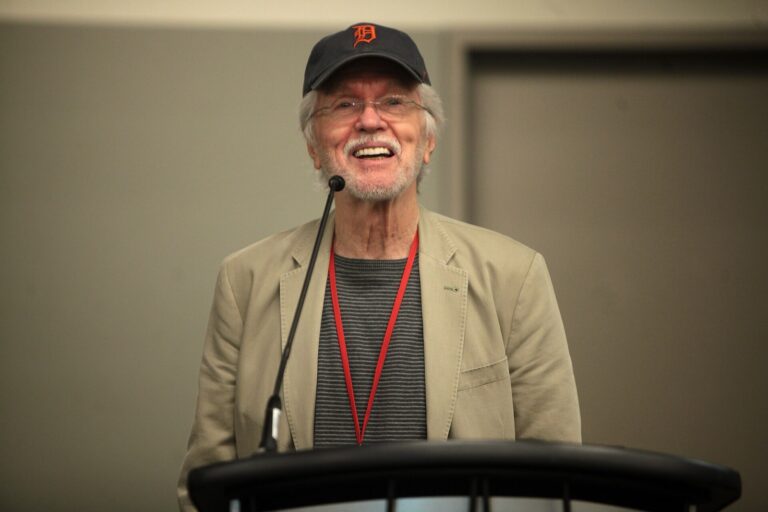
The 2026 Nobel Prize in Physics has been awarded to Francis Halzen, a University of Wisconsin-Madison professor who spent decades pursuing an unlikely idea: burying thousands of light sensors deep in the Antarctic ice sheet to catch rare signals from particles that stream across the universe.
The Royal Swedish Academy of Sciences announced the award in Stockholm on Tuesday. The Nobel committee cited Halzen “for decisive contributions to the IceCube neutrino observatory and the discovery of high-energy neutrinos of astrophysical origin.” The prize carries an award of 12 million Swedish kronor.
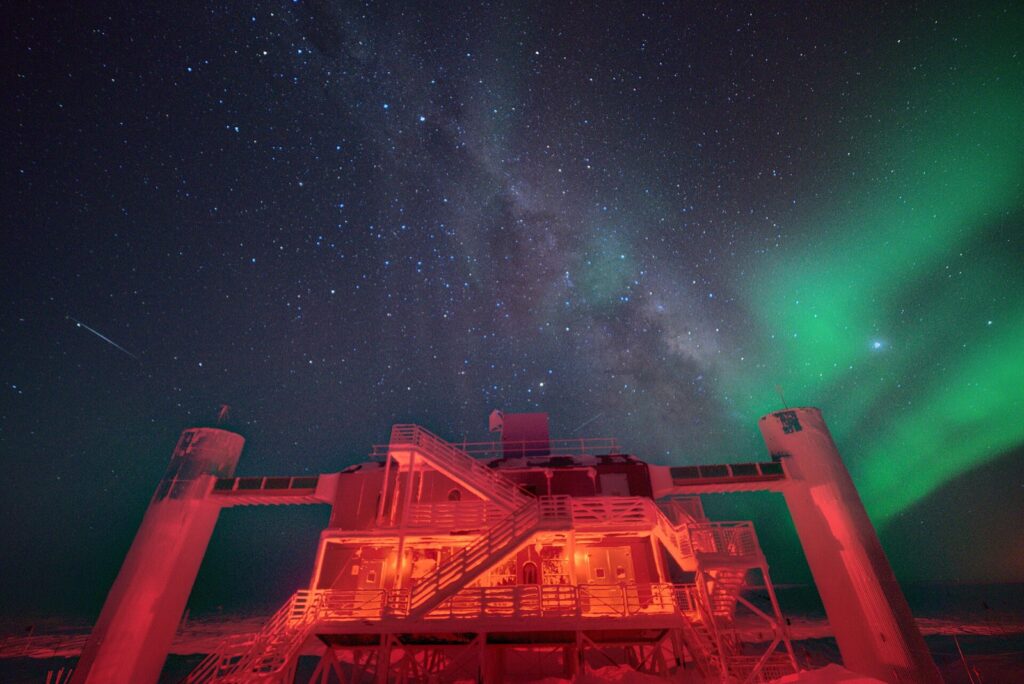
Halzen, a Belgian-born particle physicist, is the principal investigator of the NSF IceCube Neutrino Observatory, which the university describes as the world’s largest telescope. He learned of the honor while traveling in Italy, the Guardian reported.
“It feels strange,” Halzen said at a briefing after the announcement. “I hope it reflects on the really courageous people who joined me in the beginning of this project when no really respectable, conservative physicist would have joined me, but many talented people did.”
Hunting ghost particles in the ice
Neutrinos are nearly massless particles that rarely interact with ordinary matter. Billions of them from the sun pass through every person each second without leaving a trace. Occasionally, though, a neutrino strikes the nucleus of an atom and produces a faint flash of light that a sensitive instrument can record.
Halzen recognized that clear glacial ice could serve as the medium for spotting those flashes, and in 1988 he proposed converting part of the South Pole ice cap into a detector. The observatory that grew from that idea occupies a cubic kilometer of ice and uses thousands of basketball-sized optical sensors to watch for light from neutrino collisions. Its downward-facing sensors use Earth itself as a shield, picking up neutrinos that have traveled through the planet from the northern sky.
The U.S. National Science Foundation funds IceCube, which is operated by an international collaboration led by the Wisconsin IceCube Particle Astrophysics Center at UW-Madison.
A new window on the cosmos
In 2013, shortly after it was completed, IceCube reported the first detection of high-energy neutrinos originating outside the solar system. The result helped launch what scientists call multi-messenger astrophysics, in which particles such as neutrinos, along with gravitational waves, supplement light as sources of information about distant events.
Because neutrinos carry no electric charge, they travel through space in nearly straight lines, pointing back toward the cosmic engines that produced them. In September 2017, IceCube detected a high-energy neutrino traced to a supermassive black hole at the center of a distant galaxy. The observatory later found evidence of neutrino emission from an active galaxy 47 million light-years away in 2022 and from the Milky Way in 2023, according to the university. IceCube was recently upgraded in its first major expansion since construction finished 15 years ago.
Patrick Dunne of Imperial College London welcomed the choice. “For all of human history the only way we’ve been able to understand things outside our solar system is with light,” he told the Guardian. “Detecting neutrinos from astrophysical sources opens up a new lens, so it isn’t overstating things to liken this to when Galileo first pointed a telescope at the stars.”
A milestone for Wisconsin
“This is a celebration of a very unusual project,” Halzen said in a statement released by UW-Madison, crediting the university’s engineers, faculty colleagues and administrators for supporting an unconventional idea.
Interim Chancellor Eric M. Wilcots said Halzen’s concept of building a neutrino detector under almost a mile of ice had produced “a fundamental shift in how we think about the universe.”
Halzen is the sixth physicist connected to UW-Madison to win a Nobel Prize, and the award is the 23rd Nobel tied to the university, according to the school. The last active UW-Madison faculty member to receive one was Howard Temin in 1975.
Halzen said he is working on a new proposal and hopes the prize helps it win approval. Asked about speculation that neutrinos might someday be used by other civilizations to communicate, he declined to weigh in. “We have enough realistic problems to deal with right now [to] make neutrino astronomy a reality rather than worry about this,” he said.
The physics prize follows Monday’s award in physiology or medicine, which went to three scientists for optogenetics. The chemistry prize is scheduled to be announced Wednesday.
Sources
- The Guardian: Nobel prize in physics goes to Francis Halzen for south pole work on neutrinos
- University of Wisconsin-Madison: University of Wisconsin-Madison Professor Francis Halzen named 2026 Nobel laureate in physics
- NPR: Francis Halzen wins Nobel Prize in physics for work on high-energy neutrinos from space